
v3b They will beat their swords into plowshares
and their spears into pruning hooks.
Nation will not take up sword against nation,
nor will they train for war anymore.
v4 Everyone will sit under their own vine
and under their own fig tree,
and no one will make them afraid.
Micah 4:3–4
This passage spoke to the Israelites about what peace would look like. George Washington returned to it again and again in his letters. The images of peace in Micah are concrete and earthy. It’s about an end to violence, and about every household having enough and being secure. Verse 3 is the famous one, but here we want to look at verse 4.
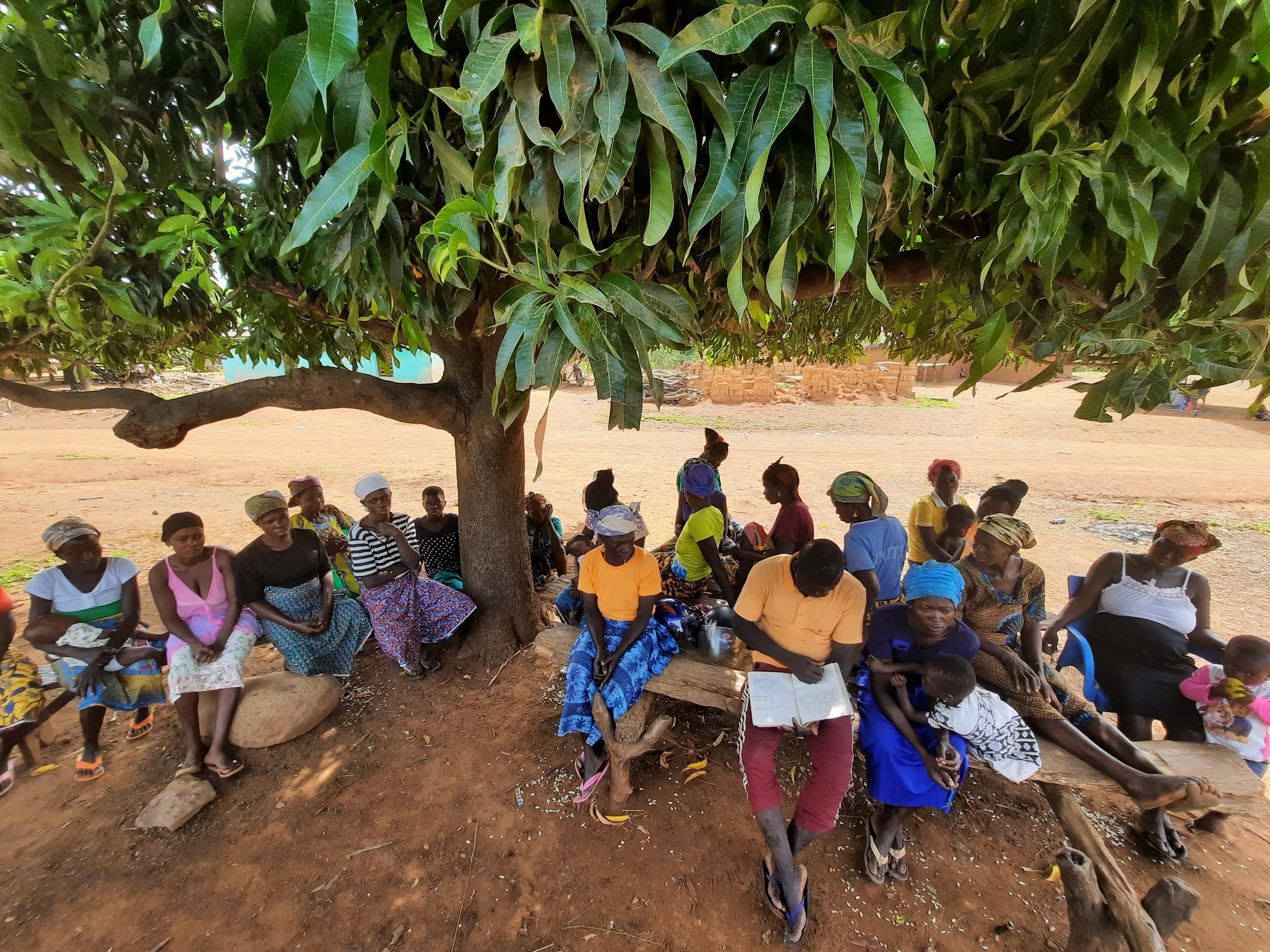
This image of peace is exactly what we heard from households in northern Ghana. One participant put it simply: “If you have assets, you will not look for trouble.” Another described how a working business changes everything: “Once your business is moving and there is money… even if someone does you something wrong, your mind is not on it.” People spoke of the security of their houses, businesses and savings, and the dignity of providing enough. As in Micah, peace and livelihoods go side by side, and it is a key reason there has been no renewed violence between the two groups.
But what fascinates us is the final phrase of verse 4: “no one will make them afraid”. This month’s technical piece explores it from a different angle. Development has come to these rural areas: schools, clinics, boreholes and markets. Beneath this, though, the questions of who owns the land and who holds traditional authority remain unresolved and contested. These were the grievances at the heart of the original conflict. People told us of being born on land and still being refused permission to build on it. Security depends not only on what you have, but on whether you can be sure it is yours.
Our evaluation showed that, on the whole, people’s economic situations are improving. With that, the two groups are mixing more and have more reason to work together. With the deadly conflict still in living memory, no one wants to threaten what has been built. And that is success.
So where does the work of peacebuilding stop? A major study of this conflict, published in 2009, was titled Ominous Calm. It described a growing calm with deep wounds left untreated. Our evaluation came to a similar conclusion: a peace built on assets is only as secure as those assets themselves.
The temptation for all of us, donors, practitioners and pastors alike, is the one Jeremiah names: “They dress the wound of my people as though it were not serious. ‘Peace, peace,’ they say, when there is no peace” (Jeremiah 6:14).
The biblical vision of peace is shalom. It is more than an end to violent conflict. It is right relationship, and it is justice. Calm and better livelihoods are an essential building block towards it. They are a foretaste of shalom, not its fulfilment. The work of peace does not stop at calm.
But this brings a real tension. Addressing the underlying issues could itself threaten the calm. So how is justice pursued? The biblical vision is both non-violent and non-complicit in injustice: it refuses violence, and it refuses to pretend the wound has healed. Holding those two together is the work of Christian peacebuilding.
“Everyone will sit under their own vine and under their own fig tree, and no one will make them afraid.”Micah 4:4
- Savings groups giving reliable credit where most could never borrow before
- Houses, businesses and livestock worth protecting
- Trade, farm work and hospitality across the ethnic line
- Hardship not blamed on the other group, even when crop prices fell
- Who owns the land, and who holds traditional authority
- People born on the land refused permission to build
- Limits on settling in the other group’s towns
- About a third still sometimes anxious around the other group
We celebrate with the CHIPS Ghana team, who for more than a decade have worked alongside both groups through savings groups, new skills to diversify income, access to medicine and sanitation. Calm like this is not small, and it was not easy. Please pray with us, and with them, for the deeper peace Micah describes, where everyone sits under their own vine and fig tree, and no one is made afraid.