Building momentum around a shared understanding of conflict in Jos, Nigeria
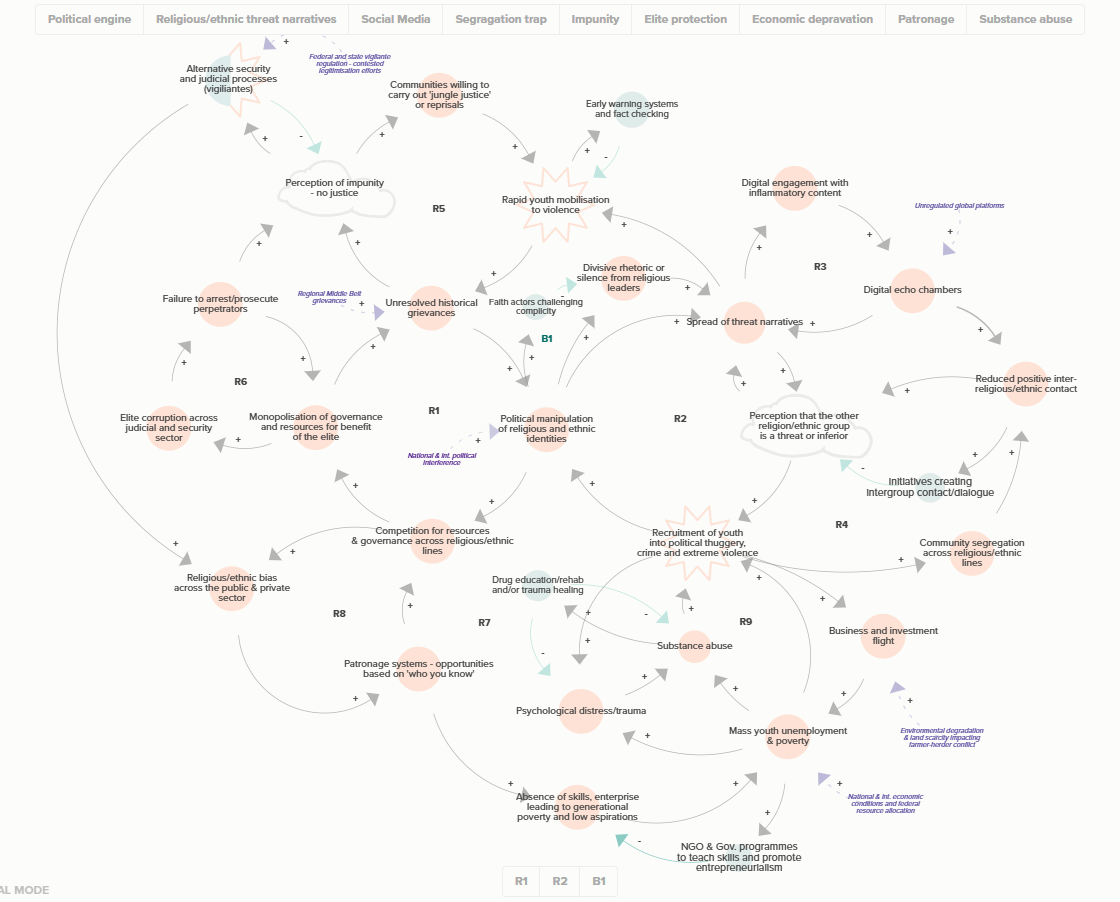
Seek Peace facilitated a participatory process mapping the factors that sustain conflict amongst youth in Jos, Nigeria. See the fully interactive map here.
Ask ten people what drives youth involvement in conflict in Jos, and you will get ten answers. Unemployment. Religion. Politics. Drugs. Old grievances. Each answer is partly right, and on its own each one is misleading, because none of them acts alone. They feed each other. That is the problem with treating conflict as a list of issues to be tackled one at a time: you fix the thing in front of you, and the system quietly routes around your solution.
So this year, working alongside our partners in Jos, we tried something different. Rather than list the problems, we mapped how they connect. It’s creating momentum!
The question
We built the work around a single question: what factors sustain conflict amongst youth aged 15 to 35 in the city of Jos, Nigeria?
Note the word sustain. We were not asking what sparks a particular riot, or who is to blame for the last one. We were asking what keeps the whole pattern going, year after year, so that the same city that grieves its dead finds itself grieving again a few years later. That is a question about a system, not an incident.
How the map was built
The map was developed through a series of workshops with local organisations who live and work in the city, supported by input from subject experts and a careful review of the academic literature on conflict in Jos and the wider Middle Belt. Seek Peace facilitated the 5 month process. We did not supply the answers. The people in the room did, because they are the ones who understand their own context.
The methodology drew on two established approaches to systems mapping, from CDA and from the Omidyar Group. In practice that meant building a causal loop diagram: a picture of the factors at play and, crucially, the arrows between them. Where one factor increases another, where a chain of effects loops back on itself and becomes self-reinforcing, where a small intervention might ripple outwards or get swallowed. The finished map holds dozens of factors and the connections between them, arranged so you can trace how pressure builds and where it might be released.
You can explore the full map here.
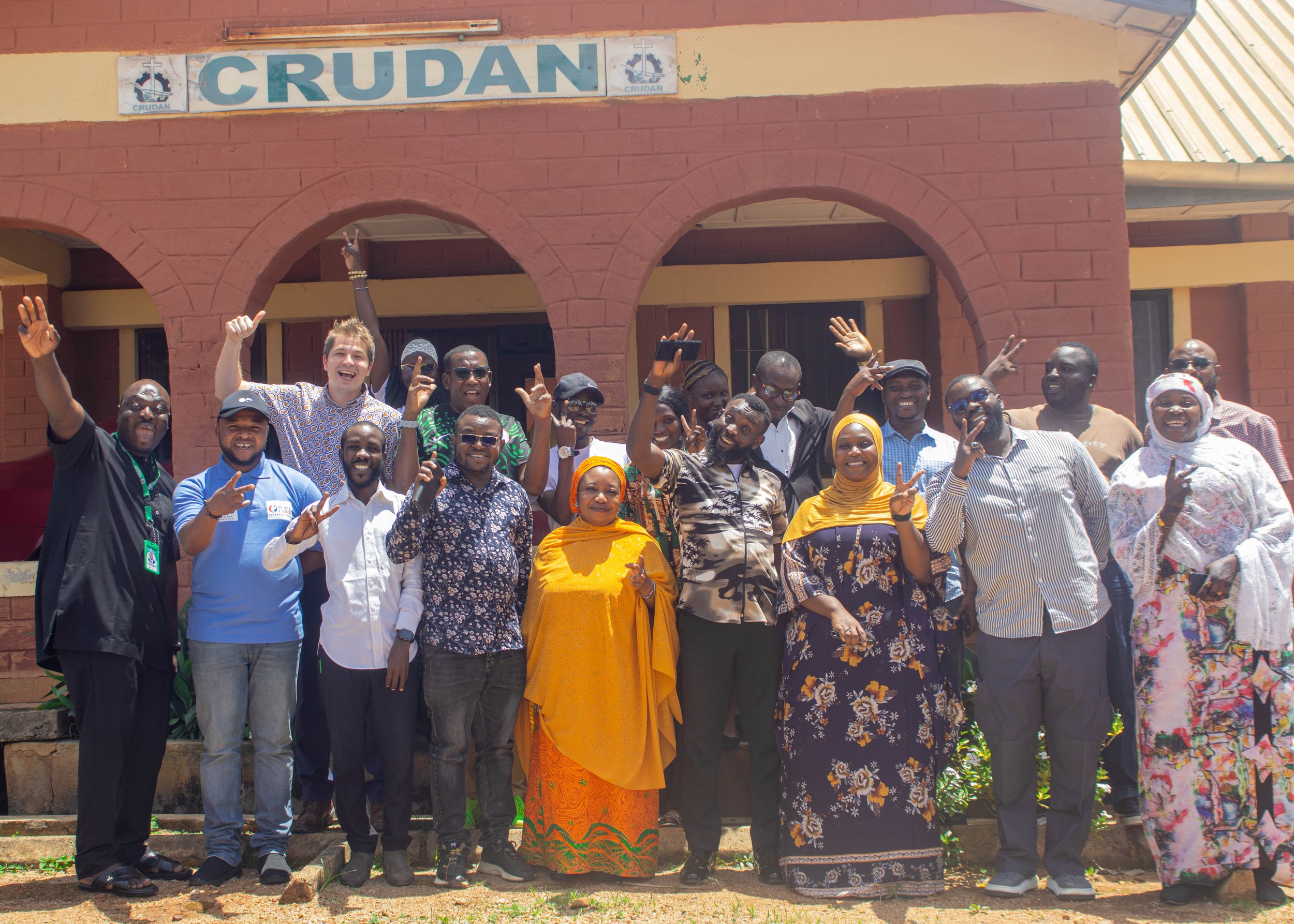
Four faith-based NGOs came together to do the mapping.
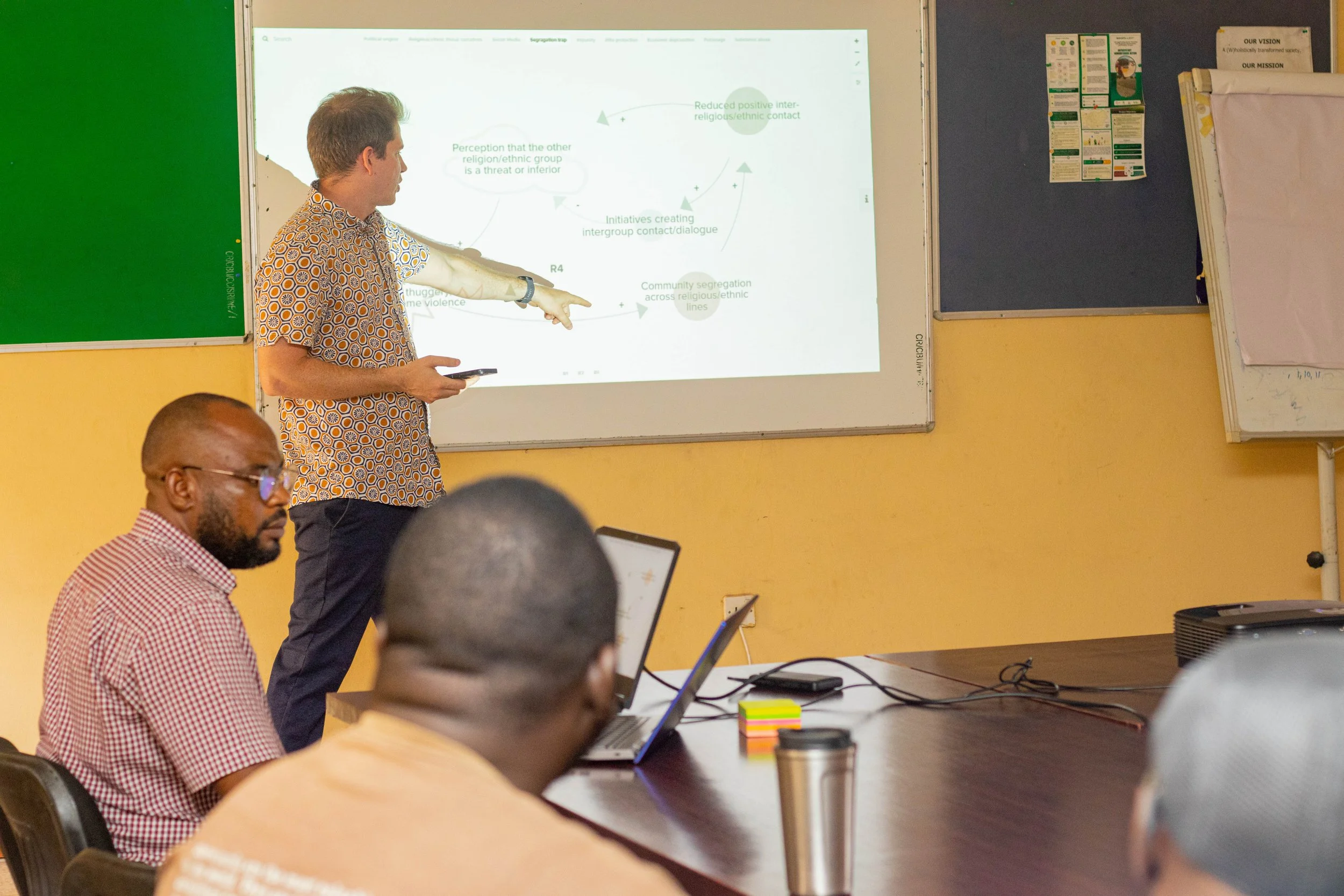
John and Agbo in Jos facilitating workshops to map the factors.
Signing it off together
A map like this is only worth anything if the people it describes recognise it as true. So the launch was not a presentation. It was a working session. Partners spent the day testing the map, challenging it, arguing with it, and correcting it, before signing it off together as an honest account of what is happening in their city. There was real energy in the room. The sign-off was deliberate, read and agreed collectively, because ownership is the whole point. A map that belongs to Seek Peace changes nothing. A map that belongs to the organisations of Jos can change how they work.
From four to nine
We launched with four organisations behind the map. Within weeks it had nine. Christian and Muslim, church and NGO, Protestant, Anabaptist, Catholic and Islamic bodies have added their names to it and agreed to come together to design interventions from it.
That is rare, and worth pausing on. Organisations in Jos do not always work across those lines, for understandable reasons. A shared, honest analysis is one of the few things that can hold such different bodies around the same table, because it lets them agree on what is happening before they have to agree on what to do. And as Nigeria approaches its 2027 elections, when tensions around youth and identity tend to sharpen, that shared table matters more, not less.
Where this is heading
The map was never the destination. It is the tool. The next phase is designing interventions together, and two are already taking shape.
One looks at digital peacebuilding for young people, countering the way conflict is increasingly stirred up online, where so many young people first meet the narratives that pull them in. Another, being developed by Agbo, responds to questions around the political pressure that religious actors face to either circulate threat narratives or remain silent. It will centre around creating confidential spaces for religious leaders to discuss and challenge narratives/actions/silence amongst leaders in their faith groups.
We are also working towards something we have wanted for a while. One of our goals in our 2025 to 2030 plan is to build a pilot fund, so that when a genuinely new idea emerges from our work with partners, we can test it quickly rather than wait a year for a grant to come through. The best ideas in this field come from the ground up, and they are often the hardest to fund. A pilot fund would let us back them while they are still fragile and new.
This is patient, unglamorous, deeply collaborative work. It is also, we believe, how a city's trajectory actually changes.